A handful of watch references have kept or increased their value over long periods, while most watches lose money the moment they leave the shop. This guide looks at five of them and the reasons behind their resilience. It describes how the market has behaved; it is not a recommendation to buy.
A caution before anything else
Watches are not a guaranteed investment. The secondary market rose sharply between 2020 and early 2022, then fell for the most sought-after steel sports models. Many people who bought at the 2022 peak have seen the value of their watch decline. Dealers take a margin on every sale, and a watch produces no income while you hold it.
The references below have a long record of holding value relative to their retail price. That record describes the past; it is not a forecast.
What tends to support value
- Brand demand that outlasts fashion. Rolex, Patek Philippe and Audemars Piguet have decades of consistent demand across markets.
- Production that lags demand. When a reference is allocated through waiting lists, the secondary market trades above retail.
- Steel sports models. Since the 1970s the strongest demand has been for steel watches with integrated bracelets or dive and chronograph heritage, rather than precious-metal dress pieces.
- Condition. Unpolished cases, original parts and intact lume carry a premium that grows with age.
- A full set. Original box, warranty card or papers, booklets and hang tags narrow the gap between asking and selling prices.
- Discontinuation. A reference's value often firms once production ends, because supply is fixed.
These factors apply across the market. Our vintage collecting guide explains condition and originality in detail.
1. Rolex Submariner
The Submariner has been in production since 1953 and is the archetype of the steel dive watch. The current date model is reference 126610LN, introduced in 2020 with a 41 mm case and the calibre 3235; its predecessor, 116610LN, ran from 2010 to 2020. Demand has exceeded supply at authorised dealers for years, which has kept second-hand prices at or above retail for most of the past decade.
The Submariner holds value because it is instantly recognisable, made in large but controlled numbers, and supported by Rolex's service network. Learn how to read the case and the rehaut in how to identify a Rolex, or start from a photograph with the Rolex identifier.
2. Rolex Daytona
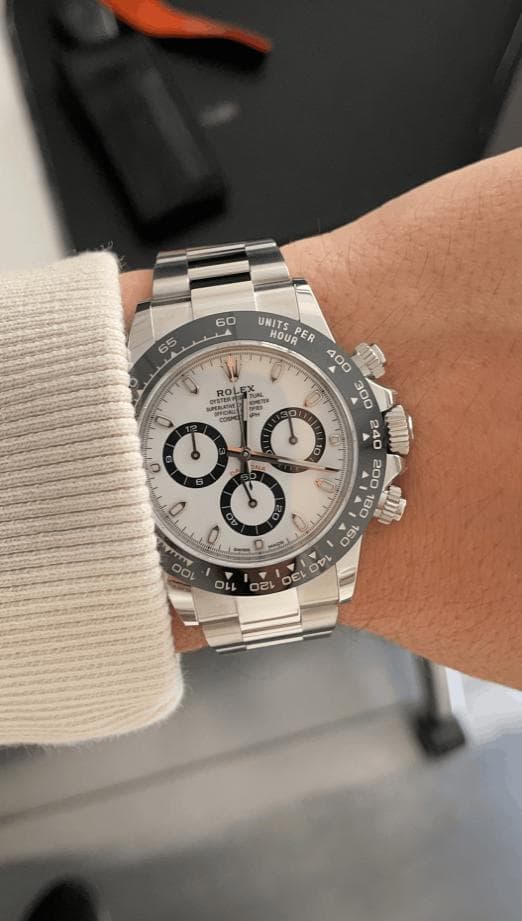
The Cosmograph Daytona was launched in 1963 and spent its first decades as a slow seller. Interest in the manually wound Paul Newman dial variants transformed its status, and since the 1990s the steel Daytona has been among the hardest watches to buy at retail. Reference 116500LN, with a black ceramic bezel, was produced from 2016 to 2023, when 126500LN replaced it.
The Daytona combines Rolex brand strength with scarcity that is more pronounced than the Submariner's, and record auction results for vintage examples lend the modern watch a halo. Both effects show in the premium it has carried over retail, even after the 2022 correction.
3. Patek Philippe Nautilus
Gérald Genta designed the Nautilus in 1976 as a steel luxury sports watch with a porthole-inspired case and an integrated bracelet. Reference 5711/1A, introduced in 2006, became the definitive modern version. Patek Philippe announced its discontinuation in 2021, and prices for the final blue, green and Tiffany-dial versions rose to levels far above retail before falling back.
The Nautilus shows both sides of the argument. Its design, brand and limited production supported its value for fifteen years, and the discontinuation fixed supply. The subsequent fall from the 2022 peak also shows how far speculative demand can carry a price away from its long-run level. Identification starts with the case shape and the horizontally embossed dial; the Patek Philippe identifier is a quick first check.
4. Audemars Piguet Royal Oak
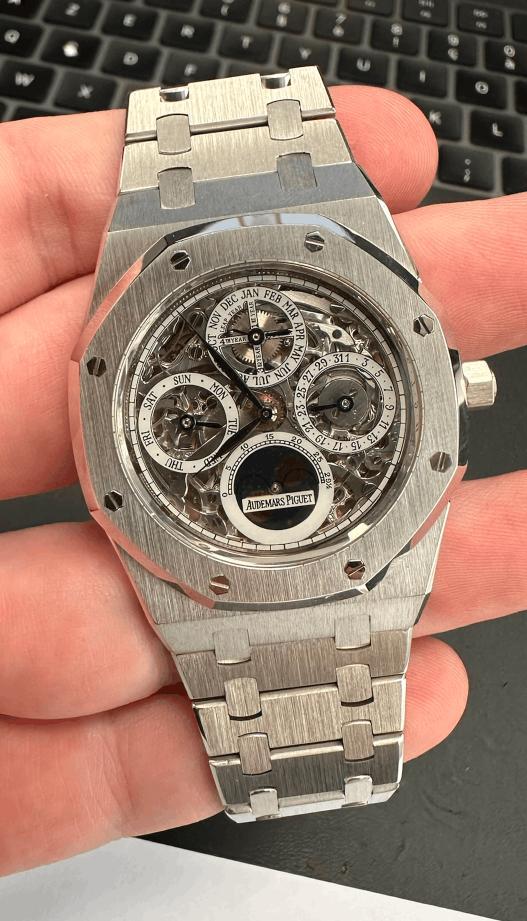
The Royal Oak preceded the Nautilus by four years. Launched in 1972, also to a Genta design, it was the first luxury sports watch in steel and was priced at launch like a gold watch. Its octagonal bezel with eight exposed screws and its tapisserie dial have been constant ever since. Reference 15500ST, introduced in 2019 with the calibre 4302, was the standard 41 mm model until the fiftieth anniversary updates in 2022.
The Royal Oak holds value for the same structural reasons as the Nautilus: a single defining design, a brand that produces in limited volume, and steel models that are allocated rather than freely sold. Its many sizes and variants mean values differ widely between references, so exact identification matters. Use the Audemars Piguet identifier as a starting point and confirm against the reference engraved on the caseback.
5. Omega Speedmaster Professional
The Speedmaster is the outlier on this list. It is produced in far larger numbers than the other four, it is available at retail without a waiting list, and it trades at or below retail on the secondary market. It belongs here because of a different kind of value retention: over decades it has lost comparatively little, held a stable floor, and vintage calibre 321 references have appreciated substantially.
The current Hesalite model, 310.30.42.50.01.001, carries the Master Chronometer calibre 3861 introduced in 2021. The Speedmaster's resilience comes from its history, covered in our Speedmaster history, from continuous production of essentially the same design since the 1960s, and from a collector base that spans entry level to serious vintage.
The five at a glance
| Watch | Example reference | Introduced | Why it has held value |
|---|---|---|---|
| Rolex Submariner Date | 126610LN | 2020 | Universal recognition, controlled supply, strong service network |
| Rolex Daytona | 116500LN | 2016 | Rolex demand plus chronograph scarcity and a vintage halo |
| Patek Philippe Nautilus | 5711/1A | 2006 | Genta design, small production, discontinued in 2021 |
| Audemars Piguet Royal Oak | 15500ST | 2019 | The original steel luxury sports watch, limited volume |
| Omega Speedmaster Professional | 310.30.42.50.01.001 | 2021 | Continuous history since 1957, stable demand, strong vintage market |
What to avoid
- Over-polished cases. Metal removed cannot be put back, and the premium for sharp cases widens as a reference ages.
- Redials and replaced parts. A refinished dial or service hands on a vintage piece can cut its value dramatically. On modern watches, aftermarket bezels, dials or diamonds hurt rather than help.
- No papers on a modern reference. For watches made in the last twenty years the warranty card is expected, and its absence invites questions.
- Mismatched sets. A card whose serial does not match the watch, or a box from the wrong era, is a warning sign.
- Counterfeits and frankenwatches. Every reference on this list is heavily faked. Read how to spot a fake luxury watch before any purchase.
Tracking the market and verifying the reference
Compare asking prices across several marketplaces, then look at completed auction results and dealer sold listings, which run below asking prices. Watch the trend over months rather than days, and treat a single data point with suspicion.
Before buying, confirm the exact reference, because adjacent references can differ in value by a wide margin. On a Rolex the reference sits between the lugs at 12 o'clock and the serial at 6 o'clock or on the rehaut; on an Audemars Piguet and a Patek Philippe the numbers are engraved on the caseback; on an Omega they are inside or on the caseback depending on the era. Match those numbers to the papers and to the dial and bezel configuration expected for that reference. Our guide to watch reference numbers covers each brand's system.
When you are starting from a photograph in a listing, WatchID returns the brand, model and reference candidates together with current marketplace listings, a fast way to see where a watch sits in the market. It identifies, it does not authenticate, so the verification steps above still apply.