Water resistance ratings are among the most misread numbers on a watch. A rating of 30 metres does not mean you can dive to 30 metres, and a 300 metre rating from 1995 means little today if the gaskets were never changed. This guide explains what the figures measure, what each level is good for, and how the rating helps identify a watch.
What metres, ATM and bar actually measure
Water resistance is tested as static pressure in a laboratory, not as depth in the sea. One bar is roughly one atmosphere (ATM) and roughly the pressure of ten metres of water, so 5 ATM, 5 bar and 50 m are the same rating expressed three ways. The test places a new, dry, motionless watch under that pressure and checks for ingress.
Real use is harsher than the test: moving your arm through water or diving into a pool adds dynamic pressure, temperature changes make seals contract and expand, and gaskets age. That is why realistic uses sit well below the number on the dial, and the figures below are guidance rather than a promise.
Rating table: what each level is good for
| Rating | Realistic use | Avoid | Examples |
|---|---|---|---|
| 30 m / 3 ATM | Rain, hand washing, splashes | Swimming, showering, any submersion | Many dress and vintage watches |
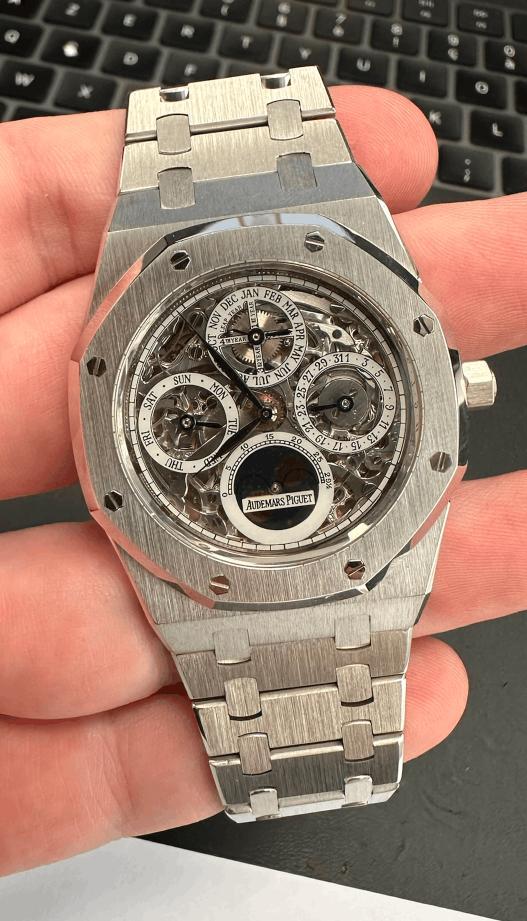
| 50 m / 5 ATM | Brief, shallow swimming if the crown is secure | Diving, water sports, hot water | Omega Speedmaster 310.30.42.50.01.001, Audemars Piguet Royal Oak 15500ST |
| 100 m / 10 ATM | Swimming, snorkelling, surface water sports | Scuba diving | Cartier Santos de Cartier WSSA0030 |
| 120 m to 200 m | Recreational scuba when the watch is a certified diver's watch | Saturation diving | Patek Philippe Nautilus 5711/1A (120 m), Tudor Black Bay GMT 79830RB (200 m), Seiko SKX007 (200 m) |
| 300 m and above | Professional and deep diving | Neglecting maintenance | Rolex Submariner 126610LN (300 m), Omega Seamaster Diver 300M, Rolex Sea-Dweller (1,220 m) |
A 120 m Nautilus is rated for swimming, not diving, because it is not built or certified as a diver's watch.
ISO 22810 and ISO 6425
ISO 22810: water-resistant watches
ISO 22810 covers ordinary water-resistant watches, with tests for immersion, overpressure, condensation and crown operation under water. A watch marked Water Resistant with a depth figure normally claims conformity with it, and the standard allows sample testing.
ISO 6425: diver's watches
ISO 6425, the stricter standard for diver's watches, requires a minimum rating of 100 m, testing of every individual watch, an overpressure test at 125 percent of the rated pressure, a condensation test, resistance to magnetism and shock, a unidirectional bezel or equivalent with clear markings, legibility at 25 cm in darkness, and a running indicator, usually a luminous seconds hand. Watches that comply may be marked Diver's with the depth, which is why Seiko dials read DIVER'S 200m. Some brands build to the standard without printing the words.
Screw-down crowns and casebacks
The crown is the most common failure point because the owner operates it. A screw-down crown threads onto a tube on the case and compresses a gasket. Left unscrewed, even a 300 m watch can take in water in a swimming pool. Check it before any contact with water, and never operate a crown while the watch is wet. Chronograph pushers are a second weak point; assume they cannot be operated under water unless the manufacturer says so.
Screw-down casebacks compress a large gasket evenly and are standard on dive watches; snap-on casebacks, typical of dress and vintage pieces, rely on a tight fit and a smaller gasket, which is one reason those watches carry lower ratings. The Rolex identification guide shows how Twinlock and Triplock crowns relate to a model's rating.
Gaskets, hot water and temperature shock
Gaskets are small rubber or synthetic rings at the crown, caseback, crystal and pushers. They dry out, flatten and crack over the years, and chlorine, salt, sweat, soap and perfume attack them. A watch is only as water resistant as its oldest gasket, which is why manufacturers recommend a service every several years, with gaskets replaced and the case pressure tested.
Showers, baths, saunas and hot tubs are worse for a watch than a swim. Heat expands the case and seals at different rates, letting vapour in even when liquid water is kept out, and soap and shampoo accelerate gasket wear. Sudden cooling, such as a hot tub followed by cold water, can draw moisture inside, where it appears as fogging. Most brands advise against hot water even for dive watches; if you see condensation, have the watch opened and dried promptly.
How to test water resistance and how often
A watchmaker tests water resistance in one of two ways.
- Dry or vacuum test: the watch sits in a chamber where air pressure is raised or lowered and a sensor measures tiny deformations of the case; if it does not return to shape as expected, air is leaking. Nothing gets wet, so this is safe for suspect watches.
- Wet test: the watch is lowered into a pressurised water tank, usually after passing a dry test; when the pressure is released, a stream of bubbles shows the leak point.
Both tests are quick and inexpensive. Have one done after any battery change, caseback opening or crown replacement, and annually if you swim with the watch. A test confirms the watch is sealed today; it does not replace worn gaskets.
Vintage watches
Treat every vintage watch as not water resistant until a watchmaker proves otherwise. Original gaskets are decades old, acrylic crystals and snap casebacks were never rated highly, and tubes and threads wear. Older dials sometimes say Waterproof, a term the industry abandoned for Water Resistant because no watch is impervious under all conditions. On a 1960s Rolex, Oyster describes the case construction, not a current guarantee. Our vintage watch collecting guide covers assessing case condition before buying.
Reading the rating on the dial and caseback
- Dial text: Rolex dive watches print the depth in metres and feet, such as 300m = 1000ft on the Submariner. Seiko prints DIVER'S 200m, and Omega prints Diver 300M on the Seamaster.
- Caseback text: many brands engrave Water Resistant with a figure in metres or bar, for example WATER RESISTANT 10 BAR.
- No figure: Water Resistant without a number implies the minimum level, for splashes only.
Depth ratings separate generations of the same model. The Rolex Submariner 5513 is marked 200m = 660ft, while the 16800 and later references read 300m = 1000ft. The Sea-Dweller 1665 reads 2000ft = 610m, and the 16660 raised it to 4000ft = 1220m. Those lines identify the reference before you remove the bracelet, and Seiko's move from 150m to 200m text separates generations of its divers. Our guides to watch reference numbers and identifying a watch from a photo explain how to combine dial text with case shape.
If you photograph a dial that shows a depth rating, WatchID, the iPhone and Android app from Horoview, uses that text along with the bezel and layout to narrow its candidates; the free web identifier works the same way and links to listings for each, so you can check the rating against what the reference should carry.