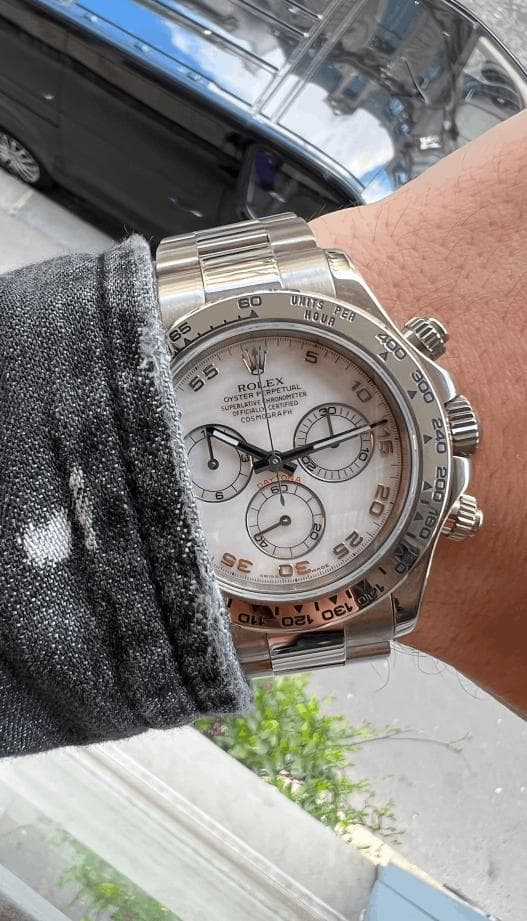
Counterfeit watches range from obvious market-stall copies to high-grade replicas that pass a casual glance. The checks below move from the easiest to the hardest and explain what a genuine watch should look like at each step. None of them is conclusive alone.
Before you start: identify the exact reference
Every check depends on knowing what the genuine watch should be. A Submariner 126610LN has a ceramic bezel and a 41 mm case; a 16610 has an aluminium insert and a 40 mm case. Judge a watch against its own reference, not against "a Rolex" in general. If you do not know the reference, our guide to watch reference numbers explains where to find it, and a photo identifier such as WatchID can propose candidates from a picture of the dial.
Identification tools, including WatchID, recognise which model a watch appears to be. They do not and cannot confirm that a particular watch is genuine; a good replica is designed to look like the real reference, so it will be identified as that reference.
Checks 1 to 4: what you can see without opening anything
1. Weight and finishing
Genuine luxury watches are made from solid steel, gold, platinum or titanium. Cheap fakes feel light, with hollow links and thin casebacks, but better fakes now match weight closely. Finishing is harder to copy: look for sharp transitions between brushed and polished surfaces, even bevels on case and lugs, and brushing that runs in one direction. Soft edges, polishing that bleeds into brushed areas and visible tool marks are warning signs.
2. Dial printing and lume
Under a loupe, genuine dial text has crisp edges, uniform letter thickness and precise spacing, and applied indices sit flat and in line with no glue or dust around them. Fakes often show fuzzy printing, uneven font weights, slightly wrong typefaces, and lume that bulges, sinks or spreads beyond its frame. All lumed elements on a genuine watch charge evenly and fade at the same rate; Rolex Chromalight glows blue, while most other brands' Super-LumiNova glows green or blue. On modern Rolex, check the rehaut: the engraved ROLEX text should align with the minute markers, with the serial at 6 o'clock and the crown logo at 12. Misalignment is a common replica failure; the Rolex identifier confirms which generation you are comparing against.
3. The date magnifier
The Rolex cyclops magnifies the date 2.5 times, so the numeral fills the window and is legible at arm's length. Many fakes use a flatter lens of around 1.5 times, leaving the numeral small inside the bubble. The cyclops should be centred over the date window and, on recent models, carries an anti-reflective coating. A cyclops on a reference that never had one is itself a red flag.
4. Seconds-hand motion
A mechanical movement advances the seconds hand several times per second: eight beats per second at 28,800 vibrations per hour (Rolex, Omega and most Swiss automatics), six at 21,600 (many Seiko calibers), ten at 36,000 (Grand Seiko Hi-Beat). A quartz movement usually steps once per second, so a supposedly mechanical watch that ticks once per second is wrong. Know the exceptions: the Rolex Oysterquartz was a genuine quartz Rolex and ticks, and Grand Seiko Spring Drive glides with no visible steps. The reverse also holds: a replica fitted with a cheap automatic movement will sweep, so a sweeping hand proves nothing. Read quartz versus automatic movements for the mechanics.
Checks 5 to 7: case, crown and bracelet
5. Caseback and engravings
Modern Rolex Oyster casebacks are plain, with no logos, text or display windows. The Deepsea, with its engraved caseback ring, is a rare exception, and exhibition backs appear only on a handful of dress models such as the Cellini Prince and the 1908. A modern Rolex sports watch with an engraved logo or a glass caseback is a fake, and Rolex stopped applying hologram stickers in the late 2000s, so one on a recent watch is also wrong. Where brands do engrave casebacks, genuine engravings are deep and even; replica engravings are shallow, blurred or in the wrong typeface.
6. Crown logo and threading
The logo on the crown should be sharp and correctly proportioned. On Rolex, the marks under the coronet tell you the crown type: three dots indicate the Triplock crown (Submariner, Sea-Dweller, Daytona), while a bar or two dots indicate the Twinlock. A screw-down crown should unscrew in a smooth, defined number of turns, pull out to crisp positions and screw back without catching. Gritty threads, wobble, or a crown that sits off-centre are red flags.
7. Bracelet and clasp
Bracelets are where many replicas fail. Check for solid links and end links that fit the case without gaps, screws rather than friction pins on brands that use screws, and a clasp that closes with a firm, quiet click. Clasp engravings should be deep and aligned. Rolex Glidelock extensions, Omega push-button clasps and Audemars Piguet folding clasps have a precise, damped feel that cheap copies rarely match. Rattling, sharp inner edges and incorrect taper for the reference are all signs to pursue.
Checks 8 to 10: movement, numbers and paperwork
8. The movement through a display back
Through an exhibition caseback, the movement is the richest source of evidence. Compare it against photos of the correct caliber for that reference: rotor shape and engraving, bridge layout, screw colours, jewel positions and finishing such as Geneva stripes or perlage. Replica movements often use a generic base with a decorated plate on top, a rotor with printed rather than engraved text, and misspelled words. The caliber must also match the reference: an Omega 310.30.42.50.01.001 should contain a caliber 3861, not an 1861, and a Patek Philippe 5711/1A should show the caliber 26-330 S C (or the 324 S C on earlier pieces).
9. Serial and reference consistency
Serial and reference engravings should be where the brand puts them, in the brand's font, and consistent with each other. A Rolex serial from the random-serial era, 2010 onwards, should not appear on a reference discontinued in the 1990s, and the serial on the warranty card must match the watch exactly. Search the serial online: counterfeiters reuse the same serial across many pieces, so one that appears on several listings with different dials or bracelets is a clear warning. Our Rolex identification guide covers where Rolex places these numbers.
10. Paperwork, boxes and warranty cards
Boxes and papers add value, which makes them worth forging, so treat them as supporting evidence only. Check that the reference and serial on the card match the watch, and that the retailer stamp and card format match what the brand issued at that time. Blank cards, mismatched serials and service papers from unknown sources are common with fakes and with watches assembled from parts. A complete set proves nothing until the watch itself has passed the other checks.
Super clones and the limits of visual checks
Super clones are replicas made with correct-grade steel, accurate dimensions and weights, ceramic bezels, and movements built to copy the genuine caliber's architecture, including what is visible through a display back. At this level, every check above can pass to the eye. What still gives them away is detail that costs more to copy than the replica sells for: the finishing of movement components under magnification, the exact behaviour of the clasp mechanism, the lume chemistry and the sapphire coatings. Those details require experience and tools.
When to get a professional authentication
Get an expert opinion whenever the price is significant, the seller is unknown, or any check above gave a doubtful result. The options are:
- the brand's own service centre, which can open the watch and verify it against its records;
- an independent watchmaker experienced with the brand, who can inspect the movement in person;
- authentication services attached to major marketplaces, which inspect the watch before releasing payment.
The strongest protection is still the seller: established dealers with a return policy and a reputation to lose are worth a premium over an anonymous private sale. For a buying framework, see the vintage watch collecting guide.
Summary of the ten checks
| Check | Genuine | Common red flag |
|---|---|---|
| Weight and finishing | Solid metals, sharp transitions, even bevels | Light, hollow links, soft edges |
| Dial and lume | Crisp print, flat indices, even glow | Fuzzy text, bulging lume, misaligned rehaut |
| Date magnifier | Rolex cyclops at 2.5x, numeral fills window | Weak magnification, off-centre lens |
| Seconds hand | Beat rate matches the caliber | Quartz tick on a mechanical reference |
| Caseback | Plain on modern Rolex, correct engraving elsewhere | Logo or display back on a Rolex sports model |
| Crown | Sharp logo, smooth threads, correct markings | Gritty threads, wrong dots or bar |
| Bracelet and clasp | Solid links, firm clasp, deep engraving | Rattle, gaps at end links, shallow marks |
| Movement | Correct caliber, engraved rotor, proper finishing | Generic base, printed text, wrong caliber |
| Serial and reference | Correct locations, fonts and eras, matches card | Reused serial, era mismatch |
| Paperwork | Consistent with watch and era | Blank or mismatched cards |