Rolex watches are among the most frequently identified, and most frequently imitated, watches on the market, which makes a systematic approach worthwhile. The brand engraves a reference number and a serial number on every watch, follows a consistent numbering logic and gives each model family a distinct set of visual cues. This guide shows where to find the numbers, how to read them and how to tell the families apart.
Where to find the reference number
The reference number is engraved on the case between the lugs at 12 o'clock. On a watch fitted with a bracelet it is hidden under the end link, so you need to remove the bracelet with a spring bar tool, or fold back the end link on older designs, to read it. The engraving is small and shallow; a loupe and raking light help. Rolex does not print the reference on the dial, so the dial alone gives you the family, not the exact model.
If you cannot remove the bracelet, the warranty card or the original papers carry the same number, and a dealer or watchmaker can read it in a minute. Never force an end link; a scratched case costs more than a spring bar tool.
How to read a Rolex reference
Rolex references have four, five or six digits, sometimes followed by letters. Four digits are vintage (a 1680 Submariner, a 1601 Datejust), five digits cover roughly the 1980s to the late 2000s (16610, 16710, 16520) and six digits are current (126610LN, 126710BLRO, 116500LN). The structure is consistent enough that collectors read it like a formula, even though Rolex has never published the rules.
Family prefixes
| Family | Five-digit examples | Six-digit examples |
|---|---|---|
| Submariner (no date) | 14060 | 114060, 124060 |
| Submariner Date | 16610 | 116610LN, 126610LN, 126610LV |
| Datejust 36 | 16234 | 116234, 126234 |
| Datejust 41 | none | 126300, 126334 |
| Daytona | 16520 | 116520, 116500LN, 126500LN |
| GMT-Master II | 16710 | 116710LN, 126710BLRO, 126710BLNR |
| Explorer | 14270 | 114270, 214270, 124270, 224270 |
| Explorer II | 16570 | 216570, 226570 |
| Oyster Perpetual | various | 124200 (34 mm), 126000 (36 mm), 124300 (41 mm) |
| Day-Date | 18238 | 118238, 128238 (36 mm), 228238 (40 mm) |
| Sea-Dweller | 16600 | 116600, 126600 |
| Deepsea | none | 116660, 126660 |
Notice that a new generation usually adds a leading 1 or changes the second digit (16610 to 116610 to 126610), so the family stays readable across decades once you know the pattern.
The material digit
The last digit of the numeric part usually indicates the case material. The convention collectors use is:
| Last digit | Material | Example |
|---|---|---|
| 0 | Stainless steel | 126610LN |
| 1 | Everose Rolesor (steel and Everose gold) | 126711CHNR |
| 3 | Yellow Rolesor (steel and yellow gold) | 126613LB |
| 4 | White Rolesor (steel with a white gold bezel) | 126334 |
| 5 | Everose gold | 126715CHNR |
| 6 | Platinum | 126506 |
| 8 | Yellow gold | 126618LN |
| 9 | White gold | 126619LB |
Suffix letters
Letters after the digits describe the bezel and come from French colour names.
- LN, lunette noire: black bezel (126610LN, 116500LN).
- LB, lunette bleue: blue bezel (126619LB).
- LV, lunette verte: green bezel (126610LV).
- BLRO, bleu et rouge: the blue and red GMT bezel (126710BLRO).
- BLNR, bleu et noir: the blue and black GMT bezel (126710BLNR).
- CHNR, chocolat et noir: the brown and black GMT bezel (126711CHNR).
- GRNR, gris et noir: the grey and black GMT bezel.
- VTNR, vert et noir: the green and black bezel of the left-handed GMT-Master II 126720VTNR.
For how other brands structure their numbers, see watch reference numbers explained.
Where to find the serial number
The serial number identifies the individual watch. Its location has moved over time:
- Between the lugs at 6 o'clock, under the end link, on watches made until the late 2000s.
- On the rehaut, the inner ring between the dial and the crystal, at 6 o'clock, from the mid-2000s onward. The rest of the rehaut carries a repeating ROLEX engraving. For a few years both locations were used.
Until 2010 serials were sequential, and from 1987 they began with a letter that changed roughly every year, which lets published dating tables place a watch within a year or two of production. Since 2010 Rolex has used random eight-character serials that cannot be dated from the number itself. The serial should match the warranty card, and on a modern watch the rehaut engraving should be crisp, evenly spaced and aligned with the dial markers.
Model families and their visual cues
Once you know the families, most Rolex watches can be placed from across a room.
| Family | Key visual cues |
|---|---|
| Submariner | Unidirectional 60-minute dive bezel, Mercedes hands, crown guards, Oyster bracelet; date versions have a Cyclops lens over the date |
| Datejust | Date at 3 under a Cyclops, fluted or smooth fixed bezel, Jubilee or Oyster bracelet, baton or Roman markers; 31, 36 and 41 mm |
| Daytona | Three sub-dials, tachymeter bezel in ceramic or metal, screw-down chronograph pushers, 40 mm |
| GMT-Master II | Bidirectional 24-hour bezel, often two-tone, an extra 24-hour hand with a triangle tip, Jubilee or Oyster bracelet |
| Explorer | Black dial with 3, 6 and 9 numerals, smooth bezel, no date; the Explorer II adds a fixed 24-hour steel bezel and an orange 24-hour hand |
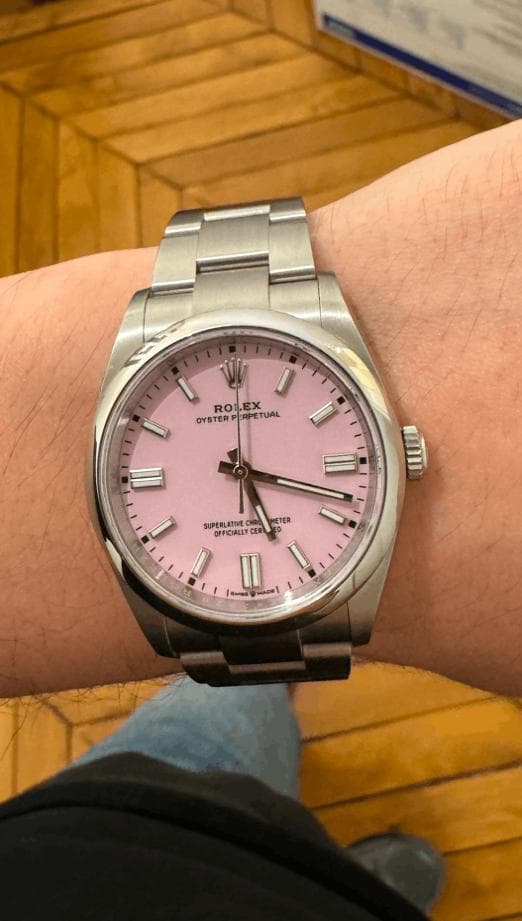
| Oyster Perpetual | Time only, no date, smooth bezel, Oyster bracelet; wide range of dial colours and sizes |
| Day-Date | Day spelled out at 12 and date at 3, President bracelet, precious metals only |
| Sea-Dweller | Submariner-like but thicker, with a helium escape valve at 9; the current 43 mm model also has a Cyclops |
Within each family, the dial text, bezel insert and bracelet narrow the reference. A Submariner Date with a green ceramic bezel and a black dial is a 126610LV; with a green bezel and a green dial it is the earlier 116610LV.
Dial text and crown logo
Rolex dials follow a fixed hierarchy: the coronet, then ROLEX, then OYSTER PERPETUAL, then the model name and function text, with SUPERLATIVE CHRONOMETER OFFICIALLY CERTIFIED above 6 o'clock on most models. At the very bottom, SWISS MADE appears on modern dials, with a tiny coronet between the two words on recent production. Earlier generations show T SWISS T for tritium, or SWISS alone during the brief transition period of the late 1990s. Since the early 2000s a small coronet has also been laser-etched into the crystal at 6 o'clock, visible at an angle under bright light. Under a loupe the printing should be sharp with clean edges, and the coronet on the dial should have five evenly rounded points.
Bracelet and clasp codes
Rolex fits four bracelet types: the three-link Oyster, the five-link Jubilee, the semi-circular three-link President reserved for the Day-Date and some Datejusts, and the Oysterflex rubber-over-metal strap on some gold sports models. Each bracelet has its own reference stamped inside the clasp, for example 93150 on the Oyster bracelet of five-digit Submariners, and the end links carry a code that corresponds to the case. Clasps made before the 2010s also carry a date code. Because bracelets are swapped and replaced, treat these codes as supporting evidence and read the general approach in how to identify a watch.
Warranty card and papers
Since the mid-2000s Rolex has issued a plastic warranty card in place of the earlier paper certificate. The card shows the reference and the selling retailer and, depending on the era, the serial and purchase date. Rolex has changed the card design several times, so the card style should be consistent with the production period of the watch. Matching numbers between card and case are the expectation for a watch sold with papers. A card on its own proves nothing, because cards are forged and sold separately.
Common look-alikes
- Tudor Black Bay and Pelagos share the Rolex design language, and older Tudors used Rolex-signed crowns and cases. The Tudor shield or rose on the dial is the tell.
- Explorer vs Oyster Perpetual. A 3-6-9 dial appears on some Oyster Perpetual models too; the Explorer's dial text names it.
- Submariner Date vs Sea-Dweller. Look for the helium valve at 9 and the thicker case; Sea-Dwellers made before 2017 have no Cyclops.
- Homage and replica watches copy the Submariner more than any other design. Dial text, hand shape and case profile are often close; the quality of the engravings and the movement are not.
Identification is not authentication
Everything above tells you which Rolex a watch is meant to be. It does not tell you whether it is genuine. Counterfeits reproduce correct reference numbers, plausible serials, rehaut engravings and even warranty cards. Confirming authenticity requires examining the movement, the finishing and the engravings in person, ideally by a watchmaker or a Rolex service centre. Read how to spot a fake luxury watch before buying from an unfamiliar seller.
For a quick first pass, an identifier such as WatchID, built by Horoview, returns the model and reference candidates from a photo together with marketplace listings, which is useful for checking that a seller's description matches the watch pictured. You can try it on the free web identifier or go straight to the Rolex page; our guide to identifying a watch from a photo explains how to get a usable result. Use it to narrow the search, then confirm the reference between the lugs and have the watch inspected before money changes hands.