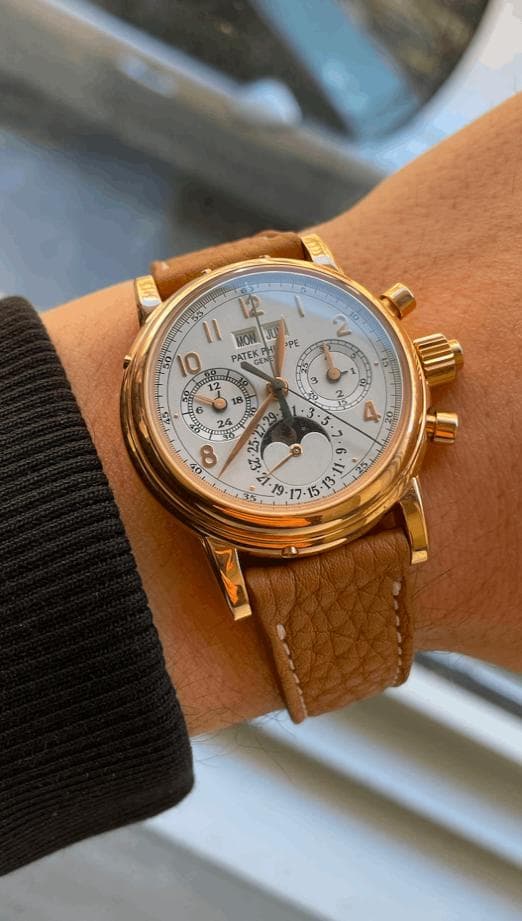
Quartz and automatic watches tell the same time in very different ways. One uses a battery and a vibrating crystal, the other a spring and a swinging balance wheel wound by your wrist. The right choice depends on what you value: accuracy and convenience, or craft, longevity and the feel of a mechanical object.
How a quartz movement works
A quartz movement runs on a small battery. The battery powers an integrated circuit that sends a current through a tiny quartz crystal shaped like a tuning fork. The crystal vibrates 32,768 times per second, the circuit counts those vibrations and emits one pulse per second, and a stepper motor turns that pulse into movement of the hands. There are very few moving parts, which is why quartz watches are cheap to make and rarely go wrong.
Quartz wristwatches reached the market at the end of the 1960s and within a decade had reshaped the industry, an episode usually called the quartz crisis. Today most watches sold worldwide are quartz.
How an automatic movement works
An automatic, or self-winding, watch is a mechanical watch. Energy is stored in a coiled mainspring and released through a gear train. An escapement lets the train advance in tiny steps, regulated by a balance wheel that swings back and forth several times a second. The common rates are 21,600, 28,800 and 36,000 vibrations per hour.
The automatic part is a weighted rotor that spins as your wrist moves and winds the mainspring. Take the watch off and it will run until the spring is exhausted, usually after two to three days, though some modern calibres run considerably longer. A hand-wound mechanical watch works the same way without the rotor.
Accuracy
Quartz is far more accurate. A standard quartz movement is typically within about 15 seconds a month, and high-accuracy quartz movements are specified to within a few seconds a year.
A good mechanical movement is accurate to a few seconds a day. The Swiss chronometer standard, COSC, requires an average daily rate between -4 and +6 seconds. Some manufacturers test to tighter in-house standards after casing: Rolex's Superlative Chronometer specification allows -2 to +2 seconds a day, and Omega's Master Chronometer certification allows 0 to +5. Position, temperature, state of wind and magnetism all affect a mechanical movement, so the rate you experience will drift over months even when the watch is well regulated.
Maintenance and running costs
A quartz watch needs a new battery every few years, a quick job at any watch shop, though a sealed dive watch should be pressure tested afterwards to keep its water resistance rating meaningful. Beyond that, servicing is rare. A quartz movement can run for decades, and when it fails it is often cheaper to replace the module than to repair it.
An automatic watch needs a full service periodically, in which the movement is disassembled, cleaned, lubricated and regulated and the gaskets are replaced. Manufacturers typically suggest intervals of several years, and the cost scales with the complexity of the movement and the prestige of the brand. Over a lifetime of ownership the mechanical watch costs considerably more to keep running.
Battery versus power reserve
A quartz watch simply runs until the battery is flat, which many models signal by moving the seconds hand in two-second jumps.
A mechanical watch's power reserve is how long it runs from full wind. Older and entry-level calibres offer around 40 hours, while modern in-house calibres commonly offer 70 hours or more; the Rolex 3235 in the Submariner 126610LN and the Tudor MT5652 in the Black Bay GMT 79830RB are both in that longer range.
Cost, feel and the seconds hand
At the entry level quartz is cheaper, often by a wide margin, because the movement costs very little. The gap narrows at the top: a Grand Seiko quartz or a Breitling SuperQuartz is priced as a serious watch because of its case, dial and movement engineering. Both quartz and mechanical watches can carry the Swiss Made label if they meet the Swiss Made requirements.
Feel is where mechanical watches win most buyers. The rotor can be felt and sometimes heard, the crown gives tactile resistance when wound, and the seconds hand sweeps in small steps rather than jumping once a second. A sweeping hand is the easiest external sign of a mechanical movement, with the exceptions covered below.
Hybrids: Spring Drive, Kinetic, solar and mecaquartz
- Spring Drive (Seiko and Grand Seiko): a mainspring and automatic winding drive the hands, but a quartz-referenced regulator replaces the escapement. The result is a perfectly smooth glide of the seconds hand with quartz-level accuracy. The Grand Seiko SBGA211 is the best-known example.
- Kinetic (Seiko): a rotor charges a rechargeable cell that powers a quartz movement. Convenient, but the cells age and eventually need replacement.
- Solar: a photovoltaic dial charges a cell that runs a quartz movement. Citizen Eco-Drive and Seiko Solar are the common names.
- Mecaquartz: a quartz base with a mechanical chronograph module, giving crisp pusher feel and a snapping reset at low cost.
Identifying the movement from the outside
You can usually tell without opening the case.
- Seconds hand: one tick per second almost always means quartz; a smooth sweep means mechanical or Spring Drive. A few quartz movements, such as high-frequency Bulova calibres, also sweep.
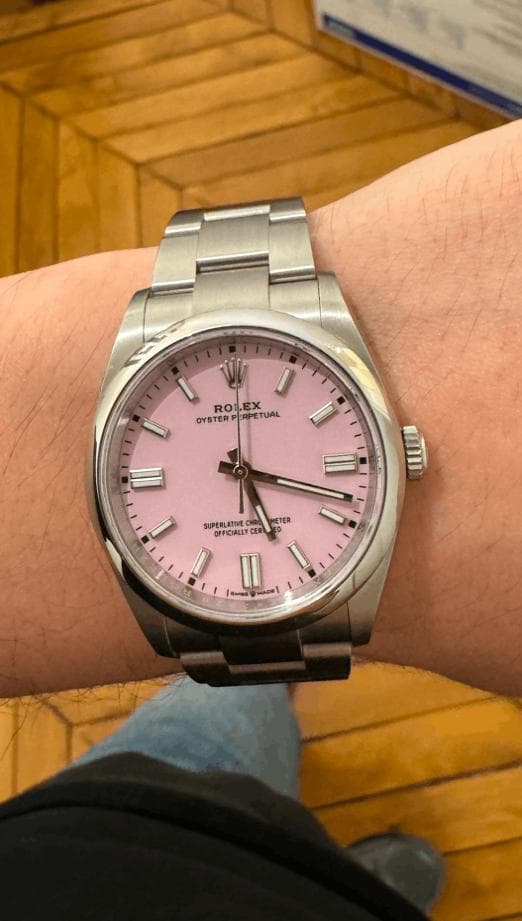
- Dial text: Automatic, Self-winding, Perpetual, Spring Drive, Eco-Drive or Quartz. Rolex uses Perpetual for its automatic movements. Many quartz watches omit the word entirely.
- Caseback: a display back showing a rotor confirms an automatic. Solid backs on quartz watches often carry a calibre number that can be looked up.
- Crown: most mechanical watches wind with resistance and the seconds hand starts moving. The Seiko SKX007 is a well-known automatic that cannot be hand wound at all, so a crown that does nothing is not proof of quartz.
- Weight and thickness: automatics are generally thicker and heavier because of the rotor.
If you are unsure, identify the reference first. Our guide on how to identify a watch walks through the steps, and WatchID identifies a watch from a photo and returns reference candidates, each of which has a published movement type. A quartz movement in a case that normally houses an automatic is one of the warning signs described in our guide to spotting fakes.
Comparison table
| Feature | Quartz | Automatic |
|---|---|---|
| Power source | Battery or solar cell | Mainspring wound by a rotor |
| Typical accuracy | Within seconds per month | Within seconds per day |
| Seconds hand | Ticks once per second | Sweeps in small steps |
| Running time off the wrist | Years on one battery | Typically two to three days |
| Routine maintenance | Battery change every few years | Full service every several years |
| Service cost | Low | Moderate to high |
| Thickness and weight | Thin and light | Thicker and heavier |
| Longevity | Modules often replaced rather than repaired | Repairable indefinitely while parts exist |
| Typical price | Lower at entry level | Higher at entry level |
Who each suits
Quartz suits anyone who wants to pick up a watch after a month in a drawer and find it correct, who works around water, dirt or knocks, or who wants a reliable tool at low cost. It also suits travellers who need a second time zone or a chronograph without the service bills.
An automatic suits buyers who enjoy the mechanism for its own sake, who wear the same watch most days, and who are comfortable with a few seconds of drift and periodic servicing. Mechanical watches also dominate the collector market, so resale and long-term interest usually favour them, as covered in our vintage collecting guide.
Neither is better in the abstract, and many enthusiasts settle on one of each.