Support: christophe@horoview.com
Longines logo
·Managing Director, Horoview

Identify a Longines From a Photo: Reference and Serial Guide

Longines has made watches in Saint-Imier since 1832 and has used the winged hourglass as its emblem since 1889, so the brand is easy to recognise. The model is another matter. The company has produced tens of millions of watches, from column-wheel chronographs of the 1930s to slim quartz dress watches, and the current catalogue reuses historic names such as Conquest, Flagship and Legend Diver on new references. Two watches that share a name can be sixty years apart.

This page explains where Longines engraves the reference and the serial, how the modern L-prefixed reference is built, how the serial on a vintage movement places a watch in a decade, what an Extract from the Archives does and does not confirm, and which visual cues separate the main collections.

Upload a photo and WatchID returns reference candidates you can check against the engravings on the caseback or the movement. Identification is not authentication: a match tells you which reference a watch appears to be, not that it is genuine or that every part is original.
Loading the identifier…

Photos are used only to identify the watch and are deleted right after the scan. Identification is not an authentication or a valuation. Privacy Policy

Where to find the reference and serial on a Longines

On a modern Longines, both numbers are on the caseback. The reference follows the format L#.###.#.##.#, for example L3.774.4.50.6, and sits alongside a serial number, the water resistance and the material. On a display caseback they are engraved around the metal rim. Both numbers are also printed on the warranty card, so a watch sold with its card can be checked in seconds.

Vintage Longines watches work differently. There is no catalogue-style reference on the outside of the case. The serial number is engraved on the movement, usually on a bridge next to the calibre designation such as 12.68Z, 30L or 13ZN, and this is the number the Longines archives are indexed by. The case carries a separate case number inside the caseback, often with the winged hourglass and metal hallmarks. The two numbers are not meant to match, and a seller who quotes only the case number has not given you what you need.

Reading the movement serial means opening the caseback, so when buying at a distance ask for a photograph of the movement. If the dial is signed Longines but the movement is not, treat the watch as unverified. For how other brands place these numbers, see our guide to watch reference numbers.

How a modern Longines reference is structured

Modern Longines references have five groups separated by full stops. Longines does not publish a decoding table, so what follows is the pattern collectors have observed: it holds well, but treat the detail as a guide rather than a rule.

  • L and one digit: the collection group. Broadly, L2 is the classic and heritage lines (Master Collection, most Heritage pieces), L3 the sports lines (HydroConquest, Conquest, Spirit, Legend Diver), L4 the slim classics (La Grande Classique, Elegant) and L5 the DolceVita.
  • Three digits: the model: case, size and movement layout. Adjacent numbers often denote sizes of the same watch; the Spirit is 810 at 40 mm and 811 at 42 mm.
  • One digit: the case material. 4 is stainless steel and covers most of the range; 5 is steel with gold cap; other digits cover gold, PVD-coated and diamond-set cases.
  • Two digits: the dial. Within a collection the same code recurs: 78 is the silver barleycorn dial across the Master Collection, 11 the white dial of the slim classics. The same digits mean something else in another collection.
  • One digit: the bracelet or strap. 6 is a steel bracelet, 7 a two-tone bracelet, and 2, 3 and 0 are leather, alligator and rubber or textile straps.
ReferenceModelHow to read it
L3.774.4.50.6Legend Diver 42 mmL3 sports, 774 Legend Diver 42 mm case, 4 steel, 50 black dial, 6 steel bracelet
L3.781.4.56.6HydroConquest 41 mmL3 sports, 781 HydroConquest 41 mm, 4 steel, 56 black dial with ceramic bezel, 6 steel bracelet
L3.810.4.53.6Spirit 40 mmL3 sports, 810 Spirit 40 mm (811 is the 42 mm), 4 steel, 53 black dial, 6 steel bracelet
L2.628.4.78.3Master Collection 38.5 mm, dateL2 classic, 628 Master 38.5 mm with date, 4 steel, 78 silver barleycorn dial, 3 leather strap
L2.909.4.78.3Master Collection Moon Phase 42 mmL2 classic, 909 Master 42 mm with moon phase, 4 steel, 78 silver barleycorn dial, 3 leather strap
L2.819.4.93.2Heritage Military 38.5 mmL2 heritage, 819 Heritage Military, 4 steel, 93 speckled silver dial, 2 leather strap
L4.209.4.11.6La Grande Classique de Longines 24 mmL4 slim classic, 209 the 24 mm quartz case, 4 steel, 11 white dial, 6 steel bracelet

The dial and strap digits change far more often than the first three groups, which is why one Legend Diver appears under several references and why a photo alone rarely settles the last three digits.

Serial numbers, dating and the Extract from the Archives

Longines has kept production ledgers since its factory opened in 1867, and its heritage department still consults them. That makes the brand unusual: the serial on a vintage Longines movement can be traced to a calibre, a delivery date and a destination. The collector tables that circulate online are compiled from real extracts and are reasonably good at the decade level, but they are approximate and Longines has never published an official version.

As decade-level anchors only:

  • Serials below about one million belong to the nineteenth century.
  • Serials from roughly one to five million cover the 1900s to about 1930.
  • Serials from roughly five to ten million cover the 1930s to the mid-1950s; the 13ZN chronographs sit in this range.
  • Serials from roughly ten to twenty million cover the mid-1950s through the 1970s, including the Conquest, Flagship, Admiral and Ultra-Chron families.
  • Above that the serial is of little use; for a modern L-reference watch the warranty card, not the serial, dates it.

The authority is the Extract from the Archives. Given the movement serial and photographs, Longines issues a document stating the calibre, the date the watch was invoiced and left Saint-Imier, and the agent or country it was delivered to, sometimes with the case metal. Longines has historically provided extracts free of charge through an online form; check the brand's heritage services page for the current procedure. A separate certificate of authenticity, which requires sending the watch to Switzerland, has also been offered.

Be clear about what the extract confirms. It tells you that a movement with that serial was made and delivered as described, not that the case and dial in front of you left the factory with it: movements are moved between cases and dials are refinished. The test is consistency between the movement serial, the case number and hallmarks and the dial style, all of which should fit the same period. Our vintage watch collecting guide covers that method for any brand.

Visual cues by collection

  • The winged hourglass: the emblem sits above the LONGINES wordmark on the dial, on the crown and on the caseback. Registered in 1889, it is one of the oldest trademarks still in use unchanged. Modern dials add Automatic or Quartz beneath the name; chronometer-certified lines add five stars.
  • Master Collection: introduced in 2005, with a pressed barleycorn dial, blued steel hands and Roman or painted Arabic numerals. Date, moon phase, retrograde and chronograph versions share the look, in 38.5, 40 and 42 mm.
  • HydroConquest: a 300 m diver with a unidirectional bezel, ceramic insert since the 2018 update, crown guards, a screw-down crown, large Arabic numerals at 12, 9 and 6 and a date at 3. Sizes run from 39 to 43 mm.
  • Conquest: the fixed-bezel sports line, with a screw-down crown and the Conquest name on the dial; the Conquest V.H.P. is the high-precision quartz version and says so on the dial.
  • Spirit: launched in 2020 as a pilot's watch, with applied Arabic numerals, a large grooved crown, Chronometer on the dial and five stars beneath the name. The Spirit Zulu Time adds a GMT hand and a bidirectional 24-hour bezel.
  • La Grande Classique de Longines: a very thin quartz dress watch from 1992, in 24 to 38 mm, usually with Roman numerals or diamond indices.
  • Legend Diver: a compressor-style diver reissued in 2007 from a 1960 original, with an inner rotating bezel driven by a second crown at 2 o'clock and the winding crown at 4. First in 42 mm, later also in 36 and 39 mm, with and without a date.
  • Heritage reissues: the Heritage Classic sector dial, the speckled-dial Heritage Military, the Heritage 1945, the Skin Diver, the Avigation BigEye chronograph and the 2022 Ultra-Chron reproduce vintage dials in modern cases. The caseback, with its L-reference and often a sapphire window, is the quickest way to tell a reissue from an original.
  • Vintage pieces: the 13ZN (from 1936) and 30CH (from 1947) are column-wheel flyback chronographs and the most sought-after Longines of all; only the movement confirms the calibre. Among three-handers, a 1950s Conquest carries an enamel fish medallion on the caseback, a Flagship a ship medallion, and the 1967 Ultra-Chron, a 36,000 vph high-beat watch, is named on its dial.

Common confusions and look-alikes

  • Longines, Tissot or Hamilton: all three belong to the Swatch Group and use ETA-built movements, so cases and layouts can look related. The reference formats differ: Longines references begin with L, Tissot's with T (T120.407.11.041.00) and Hamilton's with H (H70455533), and Longines calibres carry L names such as L888 and L688. Omega sits above Longines in the same group; see our Omega identification page.
  • Legend Diver or another compressor diver: the two-crown layout with an inner bezel was used by many brands in the 1960s and is copied by microbrands today. Look for the winged hourglass on the dial and crown and an L3.674 or L3.774 reference on the caseback.
  • Reissue or original: Heritage models reproduce 1940s and 1950s dials faithfully. Size gives it away first, as originals are mostly 33 to 36 mm, and the caseback settles it.
  • Redials: refinished dials are common on vintage Longines and sharply reduce value. Check the print sharpness, the proportions of the winged hourglass, the alignment of SWISS at the foot of the dial and the numeral fonts against period catalogue photographs. An Extract from the Archives says nothing about the dial.
  • Longines-Wittnauer: Wittnauer was the brand's United States agent, and from the 1950s the two traded as the Longines-Wittnauer Watch Co. American-market Longines were often cased locally in gold-filled or gold cases by US casemakers, so a Longines movement in a case stamped by an American maker is normal, not a sign of a marriage. A watch signed Wittnauer alone is a Wittnauer, not a Longines.
  • Counterfeits: the HydroConquest, Master Collection and La Grande Classique are all copied. Caseback engraving, barleycorn pressing and movement finishing are the places to look; our guide to spotting a fake luxury watch covers the general method.

Identifying a Longines with WatchID

Upload a photo at watchid.app/identify and WatchID compares the case, bezel, dial layout, hands and logo against known Longines models and returns ranked reference candidates. For a modern watch, match the L-reference on the caseback to the list; a 40 mm and a 42 mm Spirit look the same in a photo but carry different model digits. For a vintage watch, expect a collection and an era rather than an exact reference, since the case does not carry one, and go further with the movement serial and an Extract from the Archives.

  1. Photograph the dial straight on, with the text beneath the winged hourglass legible.
  2. Photograph the caseback, or the movement if the watch is vintage and already open.
  3. Check the candidate reference against the engraving before relying on it.

To see what a reference sells for, and to compare dial and strap variants side by side, browse the Longines listings on Horoview. If the watch turns out not to be a Longines, our Seiko page covers another brand whose caseback is unusually informative. For the general method, read how to identify a watch from a photo.

Popular Longines references

Popular Longines models with a reference example and how to recognise each
ModelReference exampleHow to recognise it
Legend Diver 42 mmL3.774.4.50.6Compressor-style diver with an inner rotating bezel driven by a second crown at 2 o'clock and the winding crown at 4; black dial on a steel bracelet.
HydroConquest 41 mmL3.781.4.56.6300 m diver with a unidirectional ceramic bezel, crown guards, Arabic numerals at 12, 9 and 6 and a date at 3; black dial on a steel bracelet.
Master Collection 38.5 mmL2.628.4.78.3Automatic with date at 3, silver barleycorn dial, Roman numerals and blued steel hands, on a leather strap; the bracelet version ends in 6.
Spirit 40 mmL3.810.4.53.6Chronometer-certified pilot's watch with applied Arabic numerals, five stars beneath the name and a large grooved crown; the 42 mm version is L3.811.
Master Collection Moon Phase 42 mmL2.909.4.78.3Barleycorn dial with a pointer date and a moon phase at 6 o'clock; the same dial code 78 as the three-hand Master Collection.
La Grande Classique de Longines 24 mmL4.209.4.11.6Very thin quartz dress watch with a white dial and Roman numerals on a steel bracelet; the 29 mm sibling uses a different model number.

Longines identification FAQ

Where is the reference number on a Longines?

On a modern Longines it is engraved on the caseback in the format L#.###.#.##.#, for example L3.774.4.50.6, next to the serial number, and printed on the warranty card. Vintage Longines watches do not carry a catalogue reference on the case; identify them from the movement serial, the calibre designation and the case number inside the caseback.

How do I date a Longines by serial number?

For a vintage watch, read the serial engraved on the movement and compare it with collector tables, which place it to within a decade: roughly one to five million is 1900 to about 1930, five to ten million the 1930s to the mid-1950s, and ten to twenty million the mid-1950s through the 1970s. These ranges are approximate; the Extract from the Archives gives the actual delivery date. For a modern watch, use the warranty card.

What is a Longines Extract from the Archives?

A document issued by the Longines heritage department from the production ledgers kept since 1867. Based on the movement serial, it states the calibre, the date the watch was invoiced and left the factory, and the agent or country it was delivered to. It confirms the movement's history, not that the case and dial are original to it, and it is not a certificate of authenticity.

What do the numbers in a Longines reference mean?

L plus one digit is the collection group (L2 classic and heritage, L3 sport, L4 slim classics), three digits are the model and size, one digit is the case material with 4 for steel, two digits are the dial and the final digit is the bracelet or strap, with 6 for a steel bracelet. Longines does not publish this table, so treat it as an observed pattern rather than a rule.

Can WatchID tell if my Longines is genuine?

No. WatchID identifies the model and reference a watch appears to be from a photo, which tells you what to check. Authentication requires comparing the caseback or movement engravings, the movement itself and the papers, and for a vintage piece an Extract from the Archives plus an inspection by a watchmaker.

Related guides

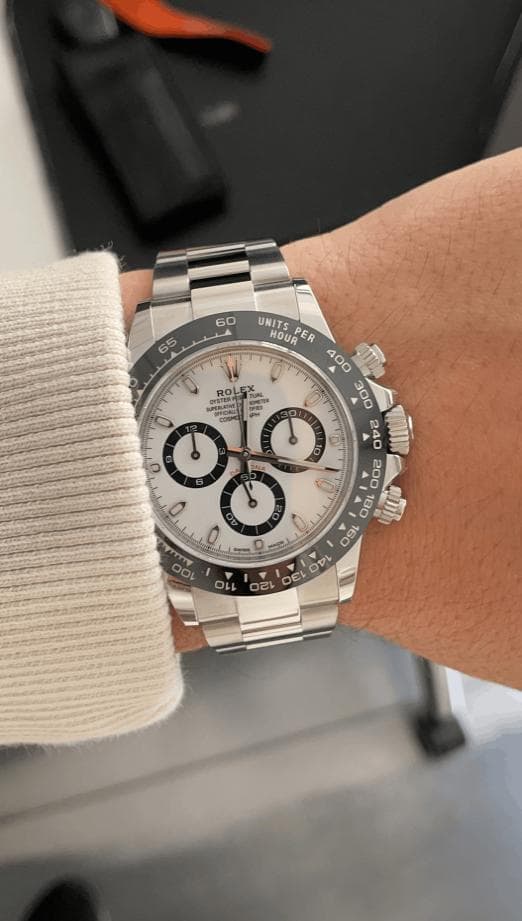
Wrist shot of a steel Rolex Daytona chronograph with a white dial and black ceramic bezel
Identification7 min read

How to Identify a Watch: A Step-by-Step Checklist

A practical checklist for identifying any watch: dial, case, caseback engravings, bracelet codes, movement and papers, plus photo-based identification.

Updated

Close-up of a wristwatch dial and case
Education7 min read

Watch Reference Numbers Explained, Brand by Brand

How watch reference numbers work at Rolex, Patek Philippe, Audemars Piguet, Omega, Cartier, Breitling, Tudor and Seiko, where to find them and how to search.

Updated